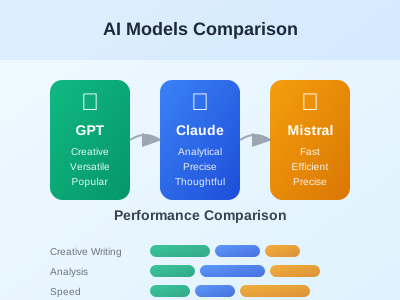
The landscape of AI language models continues to evolve rapidly, with each model offering unique capabilities and advantages.
The world of AI language models has exploded with options, each claiming to be the best. But which one should you actually use? In this comprehensive comparison, we'll break down the three most popular models available today: GPT, Mistral AI, and Claude.
Overview of the Contenders
Before diving into the specifics, let's establish what we're comparing. All three models are large language models (LLMs) capable of understanding and generating human-like text. However, they differ significantly in their training approaches, capabilities, and ideal use cases.
GPT (Generative Pre-trained Transformer)
Developed by OpenAI, GPT has become synonymous with AI text generation. The latest versions (GPT-3.5 and GPT-4) are known for their versatility and strong performance across a wide range of tasks. GPT models excel at creative writing, code generation, and general conversation.
Claude
Created by Anthropic, Claude is designed with a focus on being helpful, harmless, and honest. It's particularly strong at analytical tasks, reasoning, and maintaining context over long conversations. Claude tends to be more cautious and thoughtful in its responses.
Mistral AI
The newest player in the field, Mistral AI offers models that are both powerful and efficient. They're designed to be fast and cost-effective while maintaining high quality output. Mistral models are particularly good at following instructions precisely.
Performance Comparison
Creative Writing
Winner: GPT
GPT consistently produces the most creative and engaging content. Whether you're writing
stories, poems, or marketing copy, GPT's training on diverse creative content shines through.
It can adapt to different writing styles and tones with remarkable flexibility.
Claude comes in second, offering thoughtful and well-structured creative content, though sometimes more conservative in approach. Mistral, while capable, tends to be more straightforward and less imaginative in creative tasks.
Analytical and Reasoning Tasks
Winner: Claude
When it comes to breaking down complex problems, analyzing data, or providing detailed
explanations, Claude excels. Its training emphasizes logical reasoning and careful analysis,
making it ideal for research, academic work, and business analysis.
GPT performs well but can sometimes jump to conclusions or provide less thorough analysis. Mistral offers solid analytical capabilities, particularly for structured problems.
Code Generation and Programming
Winner: GPT
GPT's extensive training on code repositories makes it exceptional at programming tasks.
It can write, debug, and explain code across multiple programming languages with high accuracy.
Mistral shows strong performance in code generation, particularly for well-defined programming tasks. Claude is capable but tends to be more verbose in its code explanations, which can be helpful for learning but less efficient for quick solutions.
Instruction Following
Winner: Mistral AI
Mistral AI excels at following specific instructions precisely. If you need an AI that will
stick closely to your requirements without adding unnecessary embellishments, Mistral is
your best choice.
Claude also follows instructions well but may provide additional context or suggestions. GPT sometimes interprets instructions creatively, which can be either helpful or problematic depending on your needs.
Speed and Efficiency
Winner: Mistral AI
Mistral models are optimized for speed and efficiency. They provide quick responses without
sacrificing quality, making them ideal for applications where response time matters.
GPT and Claude have similar response times, though this can vary based on the complexity of the request and current server load.
Use Case Recommendations
Choose GPT When:
- You need creative content generation
- Working on programming or coding tasks
- Want versatile, general-purpose AI assistance
- Need help with brainstorming and ideation
- Creating marketing or social media content
Choose Claude When:
- Conducting research or analysis
- Need detailed explanations of complex topics
- Working on academic or professional writing
- Want thoughtful, well-reasoned responses
- Dealing with sensitive or nuanced topics
Choose Mistral When:
- You need fast, efficient responses
- Precise instruction following is crucial
- Working with structured data or formats
- Cost-effectiveness is a priority
- Building applications that need consistent output
Limitations and Considerations
GPT Limitations
- Can be overly creative when precision is needed
- Sometimes provides confident but incorrect information
- May not always follow instructions exactly
Claude Limitations
- Can be overly cautious or verbose
- Less creative than GPT for artistic tasks
- May decline requests that are actually acceptable
Mistral Limitations
- Less creative and imaginative output
- Newer model with less extensive training data
- May struggle with very complex, open-ended tasks
The Verdict
There's no single "best" AI model – it depends entirely on your specific needs. GPT remains the most versatile choice for general use, especially creative tasks. Claude excels when you need careful analysis and reasoning. Mistral shines when efficiency and precise instruction following are priorities.
The beauty of platforms like AI Text Generator is that you don't have to choose just one. You can experiment with different models for different tasks and discover which works best for your specific use cases.
Future Outlook
The AI landscape is evolving rapidly. We can expect to see continued improvements in all three models, with new versions addressing current limitations. The competition between these models ultimately benefits users, driving innovation and improvements across the board.
As these models continue to develop, we'll likely see more specialized versions optimized for specific tasks, making the choice even more nuanced and task-dependent.