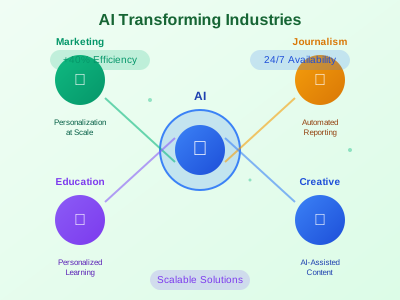
Artificial intelligence is revolutionizing content creation across industries, from marketing and journalism to entertainment and education.
We're witnessing the most significant transformation in content creation since the invention of the printing press. Artificial intelligence isn't just changing how we write—it's revolutionizing entire industries, reshaping job roles, and creating new opportunities we never imagined possible.
The Marketing Revolution
Marketing agencies and in-house teams are experiencing perhaps the most dramatic transformation. AI is enabling marketers to create personalized content at scale, something that was previously impossible without massive teams and budgets.
Personalization at Scale
Companies like Netflix and Amazon have shown us the power of personalized content, but AI is now making this accessible to businesses of all sizes. Marketing teams can now create hundreds of variations of ad copy, email campaigns, and social media posts tailored to specific audience segments.
Real-World Example:
A mid-sized e-commerce company recently used AI to create 500 unique product descriptions in multiple languages, a task that would have taken their team months. The result? A 40% increase in international sales within the first quarter.
Content Strategy Evolution
AI is shifting the role of content strategists from creators to curators and editors. Instead of spending hours writing first drafts, strategists now focus on:
- Developing AI prompts and content frameworks
- Quality control and brand voice consistency
- Strategic planning and campaign optimization
- Data analysis and performance measurement
Journalism in the AI Age
The journalism industry has been both skeptical and embracing of AI technology. While concerns about accuracy and authenticity remain valid, forward-thinking newsrooms are finding innovative ways to leverage AI while maintaining editorial integrity.
Automated Reporting
AI excels at processing large datasets and generating reports on routine topics like financial earnings, sports scores, and weather updates. This frees journalists to focus on investigative work, interviews, and complex storytelling that requires human insight.
Research and Fact-Checking
AI tools are becoming invaluable for research, helping journalists quickly sift through vast amounts of information, identify trends, and even assist with fact-checking. However, human oversight remains crucial for verification and context.
The New Journalist Role: From pure content creator to AI-assisted investigator, focusing on analysis, verification, and human-interest stories that require empathy and critical thinking.
Creative Industries Transformation
Perhaps nowhere is the AI impact more controversial—and more exciting—than in creative industries. Writers, designers, and content creators are grappling with both the opportunities and challenges AI presents.
Publishing and Literature
Authors are using AI for everything from overcoming writer's block to generating plot ideas and character development. Some are even collaborating with AI to create entirely new forms of interactive storytelling.
Screenwriting and Entertainment
Hollywood studios are experimenting with AI for script analysis, dialogue generation, and even plot development. While AI won't replace human creativity, it's becoming a powerful tool for brainstorming and iteration.
Corporate Communications Revolution
Internal communications, HR departments, and corporate training are being transformed by AI's ability to create consistent, clear, and engaging content.
Training and Documentation
Companies are using AI to create training materials, update documentation, and even generate onboarding content that adapts to different learning styles and experience levels.
Internal Communications
AI is helping HR teams craft more effective internal communications, from policy updates to company announcements, ensuring messages are clear, inclusive, and appropriately toned.
The Education Sector Shift
Educational institutions are finding innovative ways to use AI for content creation while addressing concerns about academic integrity.
Curriculum Development
Educators are using AI to create lesson plans, generate practice questions, and develop educational materials that can be quickly adapted for different skill levels and learning styles.
Personalized Learning
AI is enabling the creation of personalized educational content that adapts to individual student needs, learning pace, and interests—something that was previously impossible to scale effectively.
Challenges and Considerations
While the opportunities are exciting, the transformation isn't without challenges:
Quality Control
AI-generated content requires careful review and editing. The risk of inaccuracies, bias, or off-brand messaging means human oversight is more important than ever.
Ethical Considerations
Questions about authorship, originality, and fair use are becoming increasingly complex. Industries are still developing best practices and ethical guidelines for AI use.
Job Market Evolution
While AI is creating new opportunities, it's also changing traditional roles. The key is adaptation—professionals who learn to work with AI are finding themselves more valuable than ever.
The Skills of Tomorrow
As AI transforms content creation, new skills are becoming essential:
Looking Ahead: The Future Landscape
The transformation we're seeing today is just the beginning. As AI models become more sophisticated and specialized, we can expect:
- Industry-Specific AI: Models trained specifically for legal writing, medical communications, or technical documentation
- Real-Time Collaboration: AI assistants that work alongside humans in real-time, offering suggestions and improvements as content is created
- Multimodal Content: AI that seamlessly combines text, images, video, and audio for rich, interactive content experiences
- Predictive Content: AI that can predict content performance and optimize for specific outcomes before publication
Embracing the Change
The companies and professionals thriving in this new landscape share common characteristics: they're curious, adaptable, and view AI as a powerful collaborator rather than a threat.
The key to success isn't fighting the change—it's learning to dance with it. AI isn't replacing human creativity; it's amplifying it, allowing us to focus on what we do best: strategic thinking, emotional intelligence, and genuine human connection.
Conclusion
We're living through a pivotal moment in the history of content creation. The industries that embrace AI thoughtfully—balancing efficiency with quality, automation with human insight—will emerge stronger and more capable than ever before.
The future of content creation isn't about humans versus AI—it's about humans with AI, creating content that's more personalized, more efficient, and ultimately more impactful than anything we could achieve alone.